Flying With a Person With Alzheimer’s

airplane

My husband and I travel quite a bit, and I am learning some strategies to make life easier in the airport and in the air.  A couple of years ago, my normally mild-mannered husband yelled at an airport security agent because he was so stressed going through security.  Yikes!  I decided then and there to simplify traveling for Charles’ comfort.  Here are some things that have helped.  If your fellow traveler uses a wheelchair, some of these suggestions will need to be modified, of course.

  • Be realistic about how much help the Person With Alzheimer’s (PWA) needs in packing. We have progressed from my handing Frank the packing list, to my assisting him with packing, to my doing most of the packing myself.  To preserve his dignity and autonomy, I still involve him in making his packing list, and I set everything out on the bed near the suitcase and ask for his input before I actually pack it.
  • Make a “last minute list” for items such as a jacket, glasses, or snacks that you want to bring with you.
medicalert_jewelry

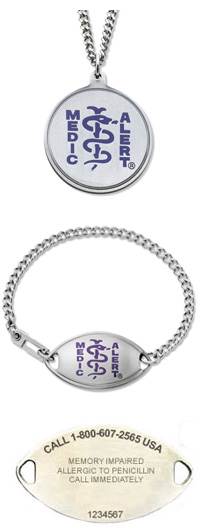
  • Be sure the PWA has some form of identification, such as the special MedicAlert + Alzheimer’s Safe Return tag.
  • If the PWA has a smartphone or tablet, install an app similar to “Find My iPhone.”  When my husband was still driving, it allowed me to guide him safely back to the hotel when he got lost (that was the end of driving while away from home).
  • Allow plenty of time for your trip to the airport.  Remember it will take the PWA much longer to get ready than you think, and you may need to go back for a forgotten item if your memory is a bit overwhelmed as well.
  • Invest in TSA PreCheck if you fly often.  For $85, you get five years of simpler travel.  You have to provide documents and go to a screening appointment, but then you don’t have to remove your hat, belt, shoes, or light jacket when you go through security.  Your laptop and zip-top bag of liquids can stay in your carryon.  This is worth its weight in gold.
  • I bought Charles a luggage tag that opens into a little mesh bag (Travelon Quick Pass).  We sit down before going through security and he empties his pockets into the bag.  Once zipped, it travels securely through the luggage scanner attached to his carryon, and he can retrieve his pocket items at his own pace when his bag comes through.

  travelon quick pass

  • I have a boarding pass holder that I use for both our boarding passes.  It has a place for a driver’s license, so I put Charles’ license in the holder with mine until we are through security.  I hand the agent both our licenses and boarding passes and take them back so I can keep track of them.
  • Once you locate your gate at the airport, don’t feel you have to wait there.  We move to a nearby gate that is within sight of the restroom doors, so that Charles can rejoin me easily when emerging from the restroom.  He gets disoriented easily in new settings, so I would not send him off to the men’s room by himself unless I was right near the door.

water-630789_640

  • Be sure to have healthy snacks and to purchase drinks once you are through security.  It will be easier for both of you to be patient if you are neither hungry nor thirsty.
  • Cough up the extra money for priority boarding so that the PWA will not feel rushed when boarding the plane and settling into the seat.  If you have been unable to get seats together, plan to arrive at the airport early and be direct about your need for disability accommodation due to Alzheimer’s (or call the airline in advance).
  • Try to minimize layovers.  It will be more confusing and exhausting if you have to go through several airports.LED_nightlight_with_switch
  • Pack a nightlight.  This will enhance safety and reduce disorientation if the PWA needs to get up at night in a strange home or hotel. (I put ours in bubble wrap.)
  • Load the PWA’s favorite music or audiobook onto a listening device with headphones for the flight.
  • If the PWA is apprehensive, remember that a calm voice and a soothing touch can help.  (If you are an anxious flyer, listen to a relaxation tape en route!)Headphones-Sennheiser-HD555
  • Bring ear plugs or noise-cancelling headphones for the PWA if the noise in the plane or hotel is likely to be bothersome.  I have found that Charles is hypersensitive to sound since his Alzheimer’s has progressed, but I’m not sure if that is true of other people.
  • Describe what is going to happen one step ahead, so you don’t overwhelm the PWA with details.  “In half an hour, we will land and change planes.”
  • Remind the PWA about using the airplane restroom prior to beginning descent (tactfully, of course: “We will be landing soon, so this might be a good time to use the restroom if you need to, honey.”
  • If you don’t have to catch a connecting flight, consider waiting until the plane has emptied out to start exiting, so that the PWA isn’t pressured to hurry.

postcard

  • Keep a travel diary by taking pictures and texting or emailing them to yourself with captions.  You can also cheat and use postcards – just jot down a sentence or two on the back.  When you get home, you can make a simple narrative about your trip with words and pictures to share with the PWA.  You will enjoy having these memories as well!

Missing My Husband (the Pre-Alzheimer’s Version)

I really miss my husband.  I know I am lucky to have him doing as well as he is, five years after his Alzheimer’s diagnosis, and I feel a bit guilty even saying this, but hey, that’s what this blog is for – true honesty about my feelings and experiences.

Charles and I have been together about a decade.  We met online, and I loved his candor, his humor, his intelligence, and (to be honest) his writing skills.  We poured our our hearts to each other.  I was widowed at 50, and ready for a relationship a couple of years later.  He was divorced twice, once after a long-term marriage and once after a brief why-the-hell-did-I-do-this marriage.  Charles was energetic, hard-working, skillful, intellectually engaged, and a pure delight.  Soon we were head-over-heels in love, the kind of love I had known when I met my first husband as a teenager and didn’t think I would find again.  We have been companions, partners in some of our work, passionate lovers, and contented householders.

We still love each other truly, and I am very grateful for that.  Charles’essential sweetness is still there, and his personality is still evident.  But there are things that bring me to tears.

I miss his playfulness with words and his enjoyment of funny things – it’s hard to have much of a sense of humor when you can’t quite wrap your brain around what is happening.  When I tell a joke or talk about something funny, by the time I explain it, the fun is gone (and he frequently still can’t see the humor).  He is often emotionally flat, not reacting with joy as he would in the past, and rarely bantering in the way that I found so charming.  (I have learned that this is fairly typical of people with Alzheimer’s.)

I miss talking to him about anything and everything.  Most of our conversation is one-sided now, hampered by his trouble in finding and understanding words.  Often that means I feel very lonely.  He wants to be supportive, but it is hard when he doesn’t know what I am talking about, despite my efforts to explain and provide context.

Without getting too personal, let’s just say that dementia tends to take away a person’s libido. As our relationship changes, it is hard to feel sexy (it’s a gap between “It’s time to cut your fingernails, darling, they are getting too long” and “I want to make passionate love with you”).  I also miss spontaneous hugs, kisses, and cuddles.  Charles enjoys those, but doesn’t initiate them, and that matters to me.

I miss gifts.  Not mink coats or trips to Paris, but the yellow roses Charles bought for me and the little earrings he picked out on special occasions.  I have tried to remind him and help him, and last Christmas a kind female friend took him shopping for a few little items for me, but I think I need to just let this go.  It is stressful for him to even participate in trying to get me a gift.

I miss working on writing projects together.  He will sit patiently with me and sometimes contribute, but it is not the same.

I miss my handyman.  My dad was the world’s least-handy person, and my first husband was equally helpless with a hammer or screwdriver, I loved having my own “Mr. Fix-It.”  Charles not only made repairs quickly and competently, but he was creative in coming up with solutions for a variety of problems around the house and the yard.  Now I either have to struggle to figure things out, or hire someone to do it.

So I have to learn to see what is there, and not what has faded or disappeared entirely.  I need to tune in to the present reality rather than focus on the past.  I must overcome my self-pity and self-absorption, while acknowledging that I do have a right to grieve.  Here we are.  I am grateful Charles can still care for himself with prompting, is physically well, and has a kind heart.  While the expression of his love for me is changed, I know it is still there.  I have to create the best life we can have together now.

The Eggs Were the Last Straw

My darling husband and I were sitting in a lovely restaurant ordering breakfast this morning.  Five minutes later, I was sniffling and looking frantically for a Kleenex in my purse.  It was all because of the eggs.

Charles was diagnosed with Alzheimer’s five years ago.  He is a kind, sweet, loving man.  Sometimes his Alzheimer’s symptoms drive me nuts, though, and I know it will only get worse.

Alzheimer’s has robbed Charles of his ability to speak fluently in certain situations, one of which is ordering food in a restaurant. It has also made him less flexible in his thinking, more dogmatic, and more stubborn.  I don’t mind helping him by ordering for him, which he has asked me to do.  I don’t mind that he basically wants a fried-egg-and-sausage breakfast or a burger-and-fries lunch or dinner when we go out, because I know it is challenging for him to remember or imagine other meals in that setting.  I didn’t even mind that after eating breakfast at the same place the day before (we were traveling, and this was the hotel restaurant), he was upset because they fried the eggs together rather than separately.  But when he became upset because I wouldn’t explain to the waiter that he wanted the eggs some other way that he could not articulate (and that I did not understand), and he raised his voice, and I saw the confusion and pity on the face of the young waiter, I lost it.

I wish I were more patient and less sensitive.  I wish I didn’t get so upset about silly things.  I wish I could focus completely on Charles’ confusion and frustration and not on my own.  I wish I didn’t feel like grinding my teeth when the eggs arrived, he continued to grouse about them (although they were exactly the same as a thousand fried eggs he has eaten since we have been together), and then he finally said, “I guess these are okay the way they are.”  I wish my emotions would trot along with my compassion and understanding, instead of breaking the harness and running away.  I wish the damn eggs hadn’t ruined the meal.