
Helping Your Partner with Dementia Through The Holidays

[Photo: Charles in 2016]

The holidays can be challenging for a person with Alzheimer’s or another dementia. Most people with dementia thrive on routine, and holiday celebrations disrupt the routine. Think about it for a moment through your partner’s eyes. They are having trouble keeping track of things and people. It takes a massive effort just to get through basic activities. Everything in their life is shifting as the dementia progresses and their ability to manage for themself decreases. And then – the holidays!

While of course the degree of challenge will depend on your partner’s stage in the dementia journey, their attitude and yours, and family dynamics, I’d like to share some tips that may make things go more smoothly.

  1. Adjust your expectations. Keeping things simple, calm, and undemanding will help your partner to enjoy the holidays. Don’t insist that they hang Christmas lights if that is a difficult chore now; consider whether having your annual party will add too much stress; and don’t expect your partner to be able to participate in the same way as last year.
  2. Prepare out-of-town family with specifics. If you expect visits from family members who haven’t seen your partner in a long time, it is kind to let them know what to expect so they aren’t shocked. Give them some guidelines for interacting with your sweetheart. When Charles was in the early stages, some family members made a trip across the country to spend some time with us. At first, they didn’t notice much difference in his abilities and behavior, but as the days went on and they saw the simple things that gave him trouble, they began to realize how much he had changed. Tell family members what you have learned: how to communicate clearly, what things might upset your partner, and what it is unreasonable to expect of them.
  3. If you are hosting a gathering, ask another person to serve as your partner’s support person. You may be busy basting the turkey at the time when your partner needs help in finding the bathroom or is asking the same question repeatedly, and there should be a designated person to provide the response or assistance your partner needs.
  4. Try to be okay with not getting a present from your partner. This was hard for me – I’m a bit of a kid when it comes to getting presents. The first year Charles had difficulty, a neighbor kindly took him to a local store and helped him to buy me a pair of earrings, which I still cherish. After that, I realized that he just couldn’t manage the “brain work” of figuring out what to get me and how to procure it. It upset me more than it should have, not because of the present itself, but because that change represented the growing lack of reciprocity in our relationship. I had to learn to let that go.
  5. Help family and friends choose appropriate presents for your partner. A gift of a Sudoku book when your partner can no longer complete the puzzles will create stress, for example. Food is always good, or something cozy, or an experience that they are still able to enjoy – all of these items may be appropriate choices. One year, Charles’ son arranged a private tour of a nearby national park, complete with transportation and a picnic lunch. It was a wonderful experience for Charles, and a stress-free activity for me as well. Perhaps several family members could join together to provide a similar gift that has meaning for your partner. If your partner is still able to enjoy outings, an offer to take them someplace they’d like would probably be a gift to both your partner and to you (in the form of respite).
  6. Prepare your partner for gatherings, but not too far in advance. If you tell your partner that your daughter will be visiting in three weeks, you may have to deal with three weeks of repeated questions about when she is coming or what is going to happen. Depending on your partner’s memory and reactions, consider the best timing for letting them know about an upcoming activity or visit. You may wish to show them pictures and reminisce about the person coming to visit, to help them remember what to expect.
  7. Let people know if your partner may not recognize them. This is always a shock to family members and close friends, and it is heartbreaking. Reassure them that even if your partner doesn’t seem to know who they are, or mixes them up with someone else, their loving presence is important and can be felt.
  8. Take your time. Allow plenty of time to get ready to go out, to answer questions, and to complete any necessary tasks. If you are rushed and harried, your partner will pick up on it and may become frustrated or even angry. Managing your own stress is a gift to your partner.
  9. Be realistic about what you can do. Maybe this isn’t the year for you to host the holiday dinner. Perhaps it’s time to order presents to be shipped to the recipients instead of trying to go to the stores, wrap everything, and send it yourself. Your house may not be decorated the way you have done it up in the past. People who care about you will understand. If someone offers help, take it – even if they can’t make Great-Aunt Susan’s sweet potato casserole as well as you do.
  10. If young children will be present, consider sending them a children’s book about Alzheimer’s before the visit so that they can be prepared as well. Give their parents some tips for how to handle the kids’ questions.
  11. Watch the booze. Eggnog, wine, beer, or punch may be part of the festivities, but your partner may be on medications that don’t interact well with alcohol. Alcohol can also affect balance and may be a risk factor for falls. Consider having nonalcoholic versions of beverages available and either substituting them or switching your partner to the G-rated version after a single drink. I used to give Charles premium grape juice in a wine glass when we were socializing with our neighbors, because he’d forget he had already had his usual glass or two and keep asking for more wine, getting grumpy if I suggested he’d had enough. He enjoyed the grape juice just as much, and didn’t seem to notice my sneaky switch!
  12. Cherish your time together. Find every aspect of the holidays that you can continue to enjoy with your partner, and enjoy it fully. Play seasonal music, make or buy their favorite holiday foods, have fun with visits, and focus on being present, patient, and positive about celebrating together.

Gifts for People in Early Stages

It can be challenging to find just the right gift for your partner.  Here are a few ideas for those in the earlier stages of dementia.  Be aware that the progression through Alzheimer’s or other dementias can vary greatly, so some of these items may only be useful for a short time, while others may be helpful for quite a while.  If your partner does not use what you have given them, even after you have supported them and demonstrated how to use it several times, it may be that they are simply no longer able to manage that particular item.  Try not to take that personally – it’s not a rebuke to you.  They just can’t do it.

Simple Memory Aids

People in the earlier stages of memory loss are often frustrated when they try to remember everyday events, activities, or plans.  Here are some memory aids that may decrease frustration if your partner is still able to write clearly and understand what they have written.

  • A whiteboard and some dry-erase pens, to be mounted in a prominent location, such as the refrigerator or the inside of your front door.
  • A pocket-sized notebook, preferably with a pen attached.
  • A simple voice recorder – make sure the controls are easy to operate.  A super-simple one I found on Amazon is called the DIGI-note Voice Recording Memo.  It has bright PLAY and RECORD buttons, and will record up to 30 seconds.  I am not endorsing this product since I haven’t used it, but it will give you an idea of what I am describing.

Everyday Electronics and Useful Items

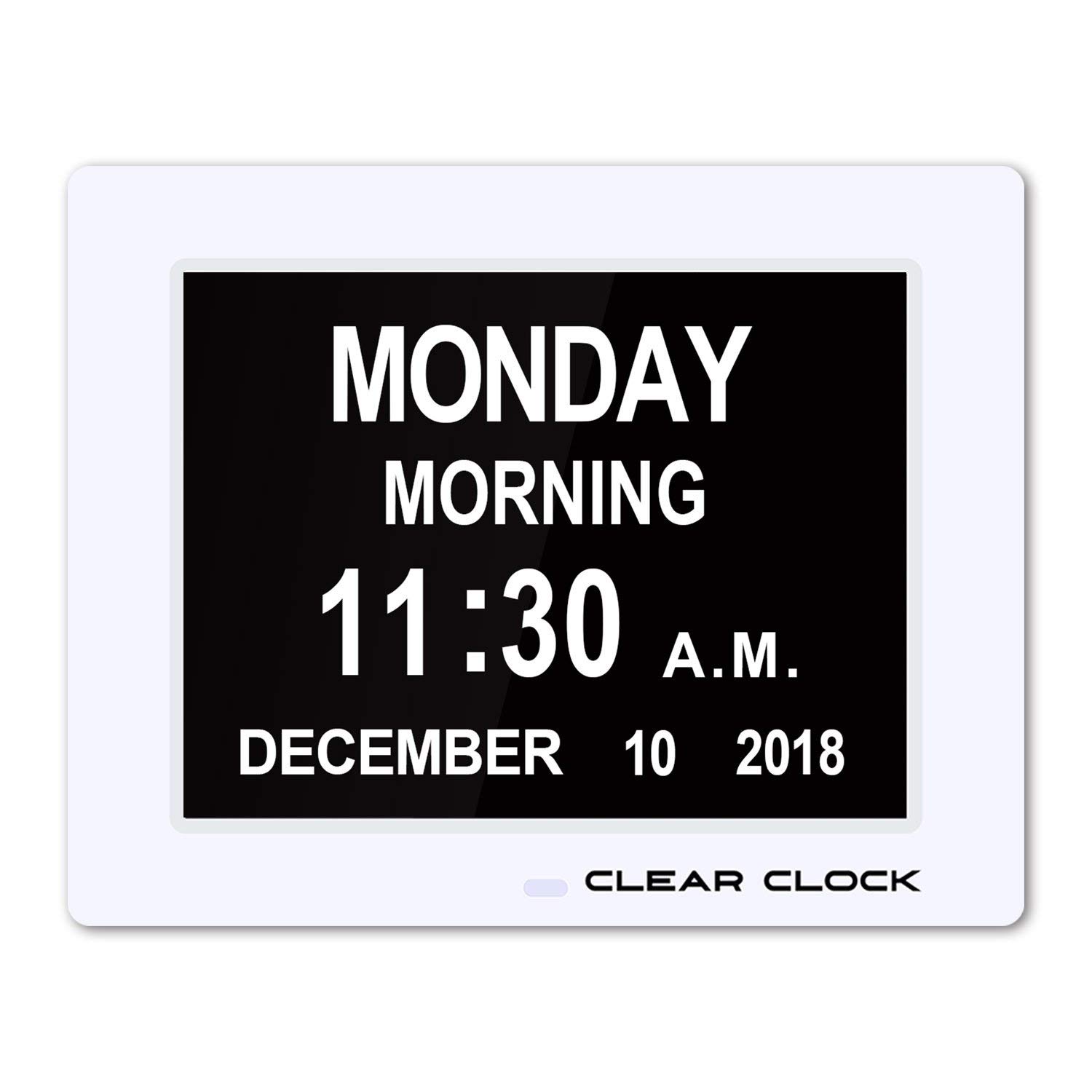
  • A clock that sets itself automatically, and includes the date and the day of the week.  The Clear Clock (pictured below)  is particularly helpful because of its simple screen and the fact that it identifies morning, afternoon, evening, and night.memory clock
  • A simplified cell phone.  The Jitterbug flip phone, widely available, is probably one of the simplest, with large buttons and easy-use features.  You can preprogram frequently used numbers.
  • A talking watch – while your partner may not have a vision problem, they may not be able to interpret the time shown on a watch.
  • A simplified remote control.  The simplest ones are easy to use, but will not work with cable or satellite service.  I put small labels on our remote control highlighting the most frequently used buttons, so my husband could find them easily.
  • A “home assistant” such as Amazon’s Alexa or Google Home.  Your partner won’t be able to set it up, most likely, but once it is set up, it may be helpful if they can remember how to use it for reminders, turning the TV on and off, and listening to music.

Experiences

Sometimes the best gift you can give is not an object, but an experience.  Be sure to take plenty of pictures so you can revisit the experience when your partner’s memory of it wanes.  Consider these options, depending on your partner’s abilities and interests:

  • A meal in a favorite restaurant.  (Make sure this is not going to be overwhelming.)
  • A local concert, where you can leave early if necessary.
  • A museum trip to a museum that represents your partner’s interests.  My husband really enjoyed going to an antique car museum with his son.  Some museums even have specialized support for those with cognitive disabilities.  We took a private tour of the Portland Art Museum.  I called ahead and explained my husband’s situation, and the terrific volunteer who conducted the tour selected a few paintings of the Grand Canyon for us to focus on, brought folding stools so we could sit down, and tailored her comments to our needs.  It was a wonderful experience.
  • A short boat tour.  Many places have one- or two-hour cruises.

Games

Simple games can help to stimulate memory skills and provide social enjoyment.  Dominoes and board games like “Sorry” may be good choices.  If you have younger family members who will play with you, you can justify getting a simple game because they will be able to play as well.

Gifts for You

If a friend or family member asks what you might like for a gift, don’t hesitate to ask for what you want and need.

  • Suggest that they take your partner out for something enjoyable (ice cream, or a movie) so that you can have time alone at home or to do something you would like.
  • If your partner is still interested in getting you a gift, but is having difficulty with the logistics, ask the friend to take your partner to a store and help them purchase something for you.  You may have to give the friend gift suggestions to help, and suggest a smaller store rather than a large confusing place.  Be sure the friend knows how much help and support your partner will need (for example, is your partner still able to manage paying for something independently?).
  • Ask your friend or family member to join you and your partner in playing a game or going out for breakfast.  It may be hard on you to enjoy these activities when your partner is not able to converse very much, and it could be fun to have others join you.

The next post will be on gifts for those with moderate or advanced dementia.


Holiday Planning for People with Dementia

Most of us (although certainly not all) enjoy the holidays.  We look forward to the hustle and bustle, family get-togethers, gift exchanges, decorations, and special food and drink.  But just imagine for a moment that you are whisked away to another planet where a holiday celebration is underway.  It’s noisy and confusing, and you have no idea what the holiday is all about.  You are asked to socialize with people (or alien beings!) that you don’t recognize, and to remember things about them even though you could swear you’ve never seen them before.  Everything you are offered to eat tastes weird.  You don’t know how long the celebration will last.  Several people there are annoyed at you, because you are not following their cherished traditions (whatever those may be).  And you are very, very tired.

Charles Xmas


Depending on the stage of dementia, this may resemble your partner’s experience of the holidays.  They may still recognize and enjoy certain aspects of the season, especially in the early to moderate stages of the journey.  As things progress, it’s likely that less and less of your usual celebration will make sense.  Some aspects of your holiday activities may be deeply distressing unless they are modified.

The first step in reducing holiday stress for your partner is to consider things from their point of view.  If they no longer recognize any of the neighbors, it’s unlikely that a big neighborhood gathering will be enjoyable.  If noise bothers them, being around 15 grandkids may not be the best choice.  If they tire easily, trying to visit all of the relatives in one day is probably not a great idea.  Think about your partner’s preferences, limitations, and capabilities as you plan what you will do.

This may be very difficult.  You may thrive on cherished family traditions, and discover it is a major loss if you can no longer participate.  There may be some compromises that will work.  A key factor is managing your own expectations.  One year, we went to my daughter’s home for Christmas.  Charles was still in the fairly early stages of Alzheimer’s, but his ability to produce and understand language was impaired.  I had to realize that his sitting alone while the rest of the family conversed was not rudeness or a lack of caring – he simply didn’t have the skills to be part of these conversations.  My strategy was to enjoy talking to the family as I usually did, but about every 20 minutes, I would go over and sit next to Charles, who seemed content to watch the Christmas tree lights.  I asked how he was doing, brought him food and drink, and perhaps told him a single highlight of the conversation I’d been enjoying, in simple language.  He did not feel neglected, and I was still able to catch up with our family.

Consider what aspects of the holidays may still be fun for your partner.  Music is often a good bet, and a short community concert might be an enjoyable activity.  If that is too much, watching a holiday special on television or listening to favorite seasonal music could be an excellent option.  Perhaps you could work on a simple craft or baking project together, so your partner is able to give a homemade gift.  Holiday lights may still delight, but they also may be confusing or disorienting.  Take your cue from your partner’s reaction.  If you are still traveling, build in some time for rest and recuperation between family visits.  If you are welcoming people at home, let your partner know it is okay to go into another room for a while if the activity level is overwhelming.

Families often gather only at the holidays, so some relatives may not have seen your partner for a year or more, and may be shocked or in denial about the changes that dementia has brought during that time period.  I sent out a family email periodically, updating close family members on Charles’ status and giving examples of things he still enjoyed doing, and things that were challenges.  When I knew people were coming to visit, I offered some suggestions about communicating with Charles and also helped them to understand behaviors that might otherwise have upset them, such as his lack of emotional reaction in some situations.  I suggested things that they might be able to do with him if they were interested.

Remember that your partner is probably still attuned to you emotionally.  If you are stressed and upset, they will be, too.  If you have moved into a caregiver role for activities of daily living, factor that in to your holiday plans.  Perhaps this is the year to give your grandchildren gift cards instead of embarking on a massive shopping and wrapping project.  Could you buy a bottle of wine for your neighbor instead of baking cookies?  Can you enlist some additional help from a family member or paid caregiver so you can run errands or have a little time to get a haircut or relax with a friend?

If you are the person who takes on much of the work for holiday meals or other traditions, scale back by asking family members, “What is the one thing that is really important to you about our holiday meal (or other tradition)?”  Then focus on those few items and omit or take shortcuts with the rest.  If you are truly at the limit of your energy and coping abilities, just say no.  Either other family members will take over your usual tasks, or they will have to do without this year.  That’s not being selfish – it’s being realistic and allowing you to support your partner as well as possible.

If your partner is in a residential facility, the facility will most likely have some sort of family-oriented celebration which you can attend, and to which you can invite a few family members, if appropriate.  Think of ways to make it special and festive for your partner and yourself.  Bringing a special dessert from home to share with some other residents, spending extra time with your sweetheart, or decorating their room with a few simple objects may help.

Because things can change rapidly with dementia, be prepared for some disappointment.  For Charles’ last Christmas, I made elaborate arrangements for a wheelchair van to pick us up at the Adult Family Home where he spent his last few months and take us to a nearby Senior Center where we had enjoyed many activities.  A favorite musician was playing guitar and singing, and I thought Charles would enjoy the music and the familiar faces.  Sadly, he was past that point.  He sat in his wheelchair, unresponsive, and just seemed tired and disconnected.  I tried, but it just didn’t work, and quite frankly, it was heartbreaking.  The prior Christmas, though, he was able to enjoy several activities, and with accommodations for his energy level and ability to participate, he had a good time.

The bottom line: Think carefully about what your partner might enjoy for the holidays.  Try to find some time for yourself, and watch your own stress levels.  Be prepared to change your plans, modify traditions, cut activities short, and ask for help.  Do your best to focus on the positive and just be grateful that you still have your sweetheart at your side.


Dementia, Identity, and Personal Dignity

My grandmother lived to the age of 107.  She was vital and active until about three years before her death, when she needed more care than I could provide, and she moved to a nursing home.  She was a dignified, independent woman who was very status-conscious.  I cringed (and sometimes spoke up) every time a caregiver called her “Florence.”  To everyone except close friends and family, she had always been “Mrs. Weisberg,” which was common usage for most middle-class women during the years of her adulthood.  In her individual case, calling her by her first name reduced her to being a child.

How we describe people is important.  When my husband Charles was diagnosed with Alzheimer’s, I read as much as I could about dementia.  I was struck by how many books and articles talked about “Alzheimer’s patients.”  Certainly, Charles had Alzheimer’s, but he was not a patient unless he was in a medical office or the hospital.  He was a person with Alzheimer’s.

Words matter.  The disability rights movement has emphasized “people first” language – for example, “a person with autism” rather than “an autistic person.”  Just as it is dehumanizing for hospital personnel to talk about “the kidney stone in room 314,” calling a person a patient just because they have a chronic disorder creates a narrow view of their identity.  Yes, Charles had Alzheimer’s.  He also had a love of The Moody Blues’ music, a taste for cheeseburgers, affection for our dog and cat, the hands of a carpenter, an interest in science and nature, and (thank heavens) a beautiful love for me.  Most of those characteristics endured in some form until the final stretch of his Alzheimer’s journey, and they made him the unique individual he was.

It is a tricky business to match your approach to the needs of a person with dementia, because the unspooling of adult behaviors occurs unevenly.  Your partner may no longer be able to manage a checking account, but they might still know very well what they want for supper.  You may need to take over their financial responsibilities, but you will want to offer preferred foods and choices for as long as your loved one can decide.  On the other hand, offering too many choices can be overwhelming once your partner can’t hold the information about alternatives in their mind.  In this case, it might be kinder to offer just a couple of choices, or to simply prepare food that you know your partner enjoys.  What matters is considering things from your partner’s point of view.

Virginia Bell and David Troxel, in their book The Best Friends Approach to Alzheimer’s Care, developed “An Alzheimer’s Disease Bill of Rights.”  They say,

Every person diagnosed with Alzheimer’s disease or a related disorder deserves the following rights:

  • To be informed of one’s diagnosis
  • To have appropriate, ongoing medical care
  • To be productive in work and play for as long as possible
  • To be treated like an adult, not like a child
  • To have expressed feelings taken seriously
  • To be free from psychotropic medications, if possible
  • To live in a safe, structured, and predictable environment
  • To enjoy meaningful activities that fill each day
  • To be outdoors on a regular basis
  • To have physical contact, including hugging, caressing, and hand-holding
  • To be with individuals who know one’s life story, including cultural and religious traditions
  • To be cared for by individuals who are well trained in dementia care

While many of these rights appear at first glance to be applicable to people who are in care facilities, they apply to people at home as well.  This may seem overwhelming to you.  I know it did to me.  As my husband moved into the moderate stages of Alzheimer’s, it became more of a challenge to help structure his day, to find meaningful activities, and to educate myself so that I was “well trained in dementia care.”  That’s one of the main reasons I am writing these blog posts – to help others fulfill these caregiving responsibilities without feeling isolated and worn out.

I’d add some other rights to this list.  Some of these are related to the rights listed above, but I think it is worth considering them separately:

  • To have experiences and challenges appropriate for their level of ability
  • To have privacy and respect for modesty to the extent possible
  • To participate in family and community activities with support
  • To be approached with a positive attitude by those who provide care
  • To make choices when it is safe and appropriate to do so

I attended a conference that included presentations by dementia experts.  One neurologist, whose name I have forgotten, said something that stayed with me.  He said that often people attribute nearly every negative behavior of a person with dementia to their condition.  The neurologist said that it is important to remember that these folks are still individuals, and to search for causes of distress before simply dismissing reactions as being due to dementia.  Perhaps the person spits out food because they don’t like the taste, or acts belligerent because a caregiver is handling them a bit too roughly.  They may not be able to describe what is bothering them, but you can often figure it out if you observe closely and try not to make assumptions.  Those “expressed feelings” in the original Bill of Rights may not be expressed in words, but they still need to be taken seriously.

You can help others treat your partner with dignity by saying positive things that describe the person as an individual.  For example, Charles was very proud of having obtained a bachelor’s degree in computer science at the age of 53.  At some point, he could no longer remember that accomplishment, but he would beam with pride when I would tell the story of how he moved from a career as a carpenter to that of a network administrator in his fifties.  I also enjoyed telling my grandmother’s caregivers some details of her extraordinary life.  I think it helped them to treat her with a bit more respect.  Our stories are important, even when we have forgotten them.  You become the keeper of your partner’s stories when they can no longer remember, and you can use those stories to remind yourself of the qualities that made you fall in love, as well as to lift up your partner’s mood, and to help others see the person who may be hidden underneath the veil of dementia.

Please Provide Input for Book to Help Partners of Those with Alzheimer’s or Other Dementias

logo1-final

AlzPartner

My husband was diagnosed with Alzheimer’s in 2010, and we dealt with this illness together for nearly eight years before his death.  I’ve learned a thing or two, and I would like to share my own knowledge (both as a partner and as a psychologist) and the knowledge of many others.  While there are resources on Alzheimer’s, I believe that it is a special situation when it is your husband, your wife, or your intimate partner who has the condition.  The dynamics are different, and the impact on your own life is enormous.

I will be interviewing experts and continuing my own research on the best possible information to help partners in their quest to cope and support.  I’d also like to hear from as many people as possible about their own experiences.

If you are the partner of a person with dementia, would you please consider taking my short, anonymous survey to share your questions, concerns, and the resources that have been helpful to you?  We are a large community, and we can learn from each other.  If you are willing to help, you can use the survey link, scan the QR Code below, or email me at AlzPartner@gmail.com and I’ll answer any questions you may have about the survey and send you a link.  Here’s the web link: https://www.surveymonkey.com/r/CKFLC87

Alz_Partner_Survey QR Code sm

You can take this survey on your smartphone, your computer, or your tablet.

Thanks in advance for sharing your wisdom and concerns.

Activities for Those with Alzheimer’s – Things to Do at Home (Part 2)

This article is a follow-on to Part 1, not surprisingly, and may make more sense if you read Part 1 first.  Each person with Alzheimer’s is different, so it is important to customize activities for the person you care for.  Most of us who are assisting a Person with Alzheimer’s (PWA) search for meaningful activities to keep our loved one as active as possible.  Here are a few things that have been helpful for my husband Charles.

First of all, I had to manage my own fear and frustration when I would offer suggestions or carefully plan activities, only to have Charles reject them.  Because he was always a hard-working, busy man, it tore at my heart to see him sitting aimlessly, staring into space.  I had to learn to let my expectations go, and to understand that there are times when he is lost in his own world, and that is okay.

Here are a few things that he enjoys at home now, in the late-moderate stage of Alzheimer’s:

  • Watching the birds.  I have a couple of bird-feeders positioned where he can see them from the living room, and we are both entertained by the variety of feathered friends who come to visit.  Even the antics of thieving squirrels are fun to watch!
  • Listening to music.  The Pandora app on our Smart TV is a godsend.  You can set up a channel by era or artist, and for a small monthly fee, it plays commercial-free.
  • Watching nature shows.  There is an endless assortment of gorgeously photographed nature shows on Netflix (I really like most of the BBC shows).  Charles can’t operate a remote control any more, but he truly appreciates the natural beauty in these shows.  There is no need to follow a plot line or to remember characters (a bear is just a bear, after all), so these work very well for people with memory loss.
  • Folding washcloths.  It’s hard to come up with chores that a person with limited memory and mobility can do, but everyone likes to feel useful.  We go through a lot of washcloths, so my praise and appreciation for his folding (which he does meticulously, if slowly) is genuine.  Find a household chore that is within the person’s capability range, and pile on the positive feedback.
  • Using a coloring app on an iPad.  Charles (who used to be a computer guy) can no longer operate his iPad independently, but I set up the Colorfy app and gave him a stylus.  All he has to do is to touch a color and then touch the area he would like to color.  He needs assistance to do this, but it is instantly rewarding, and easier for him than coloring with pens or pencils, which his tremor made very difficult.  Some folks with dementia might enjoy the sensation of using colored pencils or crayons, however.  Any sort of art activity that works for the individual is a great choice.
  • Looking at photographs together.  He can no longer identify family members or even his younger self, but when I tell him who is in the picture and explain who that person is, he enjoys it.  The key is not to quiz the PWA – “Do you know who this is?”  You don’t want them to feel inadequate.
  • Looking at art books or magazines with colorful photographs, such as National Geographic.  Charles can no longer read, but he will page through these books and magazines with pleasure.
  • Dangling a toy for the cat.  This is a two-minute project, but it is good for the cat and good for a few laughs.
  • Doing special jigsaw puzzles (which I buy on amazon.com).  There is a beautiful line of puzzles for people with dementia (Keeping Busy).  The pieces are color-coded and bagged in small groups.  I confess that after buying a few of the lovely but pricey puzzles, I began to create my own.  I found that Cobble Hill had the same or similar puzzles (35-piece puzzles with a hard cardboard backing tray on which to assemble the pieces).  I divided the puzzle into about 7 areas (5 pieces each), and used a colored marker on the back of the pieces to indicate which group belonged together.  Each color group of pieces goes into a small ziplock bag.  Then I used the same color maker to outline the places where the pieces go on the backing tray.  Charles needs a little help to get started, and I only give him one color-coded group of pieces at a time, but this works great, at less than half the cost of the pre-made sets.  Hints: Use a solid-color contrasting tablecloth under the puzzle pieces to make it easier for the PWA to see them.  If the person is having a tough time, hand them a piece at a time, facing the way it needs to be for the puzzle, and remind them, “This goes in the green area,” indicating where that is.

Routine is helpful and important for many people with Alzheimer’s and other dementias.  A typical day at home might go something like this:

  • I get up and prepare our breakfasts.  I return and awaken Charles (who is dozing lightly at this point), get him washed and changed, and set him up with breakfast.  He can still feed himself, but cannot prepare food or clear his dishes.
  • Bathroom break.  Many people with Alzheimer’s are unaware that they need to use the toilet.  Rather than ask, I simply say, “Let’s go to the bathroom, now that you’ve had your breakfast.”
  • Listening to music and watching the birds.  Since I work from home, I get Charles set up and check on him periodically.
  • I might give him a basket of washcloths to fold before lunch a couple of times a week – giving him plenty of time, and not expecting him to do anything else like talk to me or watch a show, because he needs to concentrate.
  • Lunch, which we eat together.  I confess I often put the TV on during meals (something I used to abhor), because he can’t really carry on a conversation and I hate eating in silence.
  • Bathroom break.
  • Nature shows, which I set up and he watches while I work.  Each one lasts about 45-60 minutes, so that is a reminder to get up, talk to him, check to see if he needs anything, and put on another.  He might nap while watching – that’s certainly ok!
  • Jigsaw puzzle or coloring on the iPad, which we do together.
  • Bathroom break.
  • Supper together.
  • True confession time:  I’m usually tired enough after supper that we watch a couple of TV shows together.  He can’t really follow the plot, but he enjoys some of the familiar characters.  I used to pause the shows and explain what was happening, but this is no longer helpful.  I often choose talent shows or something similar because we both enjoy them and there is no real plot to follow.
  • If I look at Facebook or play an online word game, I’ll describe what I am doing and help him to feel included in my activity.
  • Time to wash up and get ready for bed, with lots of assistance!

There are many online suggestions of more demanding activities for people earlier in the disease process, such as cooking or gardening.  Since the two of us do quite a few things out and about (see Part 1 of this blog post), these quiet days are relaxing for Charles and productive for me.  If you are caring for someone who needs in-the-room supervision or has more challenging behaviors, of course you will have to make major modifications to these suggestions.

One of the most useful things to do in planning activities is to check your expectations.  Talk to members of your caregiver support group, a healthcare provider, or a trusted friend or family member.  Most of all, observe your loved one to see if you are expecting too much or too little.  One woman I know complained bitterly that her husband was not helping her with chores in the house and yard, and spent most of his time on the couch napping.  It turns out that he was entering the final stages of Alzheimer’s, was nearly 90 years old, and had multiple medical problems.  Expecting him to leap off of the couch and offer to water the garden was completely outside of the realm of reality.

When the person you care for is your partner, it is even more challenging to maintain realistic expectations.  We used to share the chores and help each other all the time.  Charles was always willing to lend me a hand, do the physically difficult tasks, and work alongside me in the house as well as doing massive amounts of yard work.  In truth, it’s hard not to feel sorry for myself sometimes when I am doing everything that needs to be done, from mowing the lawn to hauling out the trash, and he is sitting in the living room looking at a magazine.  I have to remind myself that he would do much more if he could.  Right now, he is unsteady on his feet, can’t follow verbal instructions, and is unable to plan and process tasks; therefore, it makes no sense to expect him to offer meaningful help (with the exception of those beautifully folded washcloths!).

Now, I have to derive my satisfaction from making sure that he is engaged in life to the extent possible, and that he is comfortable and satisfied with the “now” in which he exists.  His needs change from day to day, week to week, and month to month, so I have to change my expectations and strategies to match.  Most important, I have to remember to do so with a smile and a kiss, so that we both have a good day.

Missing My Husband (the Pre-Alzheimer’s Version)

I really miss my husband.  I know I am lucky to have him doing as well as he is, five years after his Alzheimer’s diagnosis, and I feel a bit guilty even saying this, but hey, that’s what this blog is for – true honesty about my feelings and experiences.

Charles and I have been together about a decade.  We met online, and I loved his candor, his humor, his intelligence, and (to be honest) his writing skills.  We poured our our hearts to each other.  I was widowed at 50, and ready for a relationship a couple of years later.  He was divorced twice, once after a long-term marriage and once after a brief why-the-hell-did-I-do-this marriage.  Charles was energetic, hard-working, skillful, intellectually engaged, and a pure delight.  Soon we were head-over-heels in love, the kind of love I had known when I met my first husband as a teenager and didn’t think I would find again.  We have been companions, partners in some of our work, passionate lovers, and contented householders.

We still love each other truly, and I am very grateful for that.  Charles’essential sweetness is still there, and his personality is still evident.  But there are things that bring me to tears.

I miss his playfulness with words and his enjoyment of funny things – it’s hard to have much of a sense of humor when you can’t quite wrap your brain around what is happening.  When I tell a joke or talk about something funny, by the time I explain it, the fun is gone (and he frequently still can’t see the humor).  He is often emotionally flat, not reacting with joy as he would in the past, and rarely bantering in the way that I found so charming.  (I have learned that this is fairly typical of people with Alzheimer’s.)

I miss talking to him about anything and everything.  Most of our conversation is one-sided now, hampered by his trouble in finding and understanding words.  Often that means I feel very lonely.  He wants to be supportive, but it is hard when he doesn’t know what I am talking about, despite my efforts to explain and provide context.

Without getting too personal, let’s just say that dementia tends to take away a person’s libido. As our relationship changes, it is hard to feel sexy (it’s a gap between “It’s time to cut your fingernails, darling, they are getting too long” and “I want to make passionate love with you”).  I also miss spontaneous hugs, kisses, and cuddles.  Charles enjoys those, but doesn’t initiate them, and that matters to me.

I miss gifts.  Not mink coats or trips to Paris, but the yellow roses Charles bought for me and the little earrings he picked out on special occasions.  I have tried to remind him and help him, and last Christmas a kind female friend took him shopping for a few little items for me, but I think I need to just let this go.  It is stressful for him to even participate in trying to get me a gift.

I miss working on writing projects together.  He will sit patiently with me and sometimes contribute, but it is not the same.

I miss my handyman.  My dad was the world’s least-handy person, and my first husband was equally helpless with a hammer or screwdriver, I loved having my own “Mr. Fix-It.”  Charles not only made repairs quickly and competently, but he was creative in coming up with solutions for a variety of problems around the house and the yard.  Now I either have to struggle to figure things out, or hire someone to do it.

So I have to learn to see what is there, and not what has faded or disappeared entirely.  I need to tune in to the present reality rather than focus on the past.  I must overcome my self-pity and self-absorption, while acknowledging that I do have a right to grieve.  Here we are.  I am grateful Charles can still care for himself with prompting, is physically well, and has a kind heart.  While the expression of his love for me is changed, I know it is still there.  I have to create the best life we can have together now.

The Eggs Were the Last Straw

My darling husband and I were sitting in a lovely restaurant ordering breakfast this morning.  Five minutes later, I was sniffling and looking frantically for a Kleenex in my purse.  It was all because of the eggs.

Charles was diagnosed with Alzheimer’s five years ago.  He is a kind, sweet, loving man.  Sometimes his Alzheimer’s symptoms drive me nuts, though, and I know it will only get worse.

Alzheimer’s has robbed Charles of his ability to speak fluently in certain situations, one of which is ordering food in a restaurant. It has also made him less flexible in his thinking, more dogmatic, and more stubborn.  I don’t mind helping him by ordering for him, which he has asked me to do.  I don’t mind that he basically wants a fried-egg-and-sausage breakfast or a burger-and-fries lunch or dinner when we go out, because I know it is challenging for him to remember or imagine other meals in that setting.  I didn’t even mind that after eating breakfast at the same place the day before (we were traveling, and this was the hotel restaurant), he was upset because they fried the eggs together rather than separately.  But when he became upset because I wouldn’t explain to the waiter that he wanted the eggs some other way that he could not articulate (and that I did not understand), and he raised his voice, and I saw the confusion and pity on the face of the young waiter, I lost it.

I wish I were more patient and less sensitive.  I wish I didn’t get so upset about silly things.  I wish I could focus completely on Charles’ confusion and frustration and not on my own.  I wish I didn’t feel like grinding my teeth when the eggs arrived, he continued to grouse about them (although they were exactly the same as a thousand fried eggs he has eaten since we have been together), and then he finally said, “I guess these are okay the way they are.”  I wish my emotions would trot along with my compassion and understanding, instead of breaking the harness and running away.  I wish the damn eggs hadn’t ruined the meal.