It can be challenging to find just the right gift for your partner. Here are a few ideas for those in the earlier stages of dementia. Be aware that the progression through Alzheimer’s or other dementias can vary greatly, so some of these items may only be useful for a short time, while others may be helpful for quite a while. If your partner does not use what you have given them, even after you have supported them and demonstrated how to use it several times, it may be that they are simply no longer able to manage that particular item. Try not to take that personally – it’s not a rebuke to you. They just can’t do it.
Simple Memory Aids
People in the earlier stages of memory loss are often frustrated when they try to remember everyday events, activities, or plans. Here are some memory aids that may decrease frustration if your partner is still able to write clearly and understand what they have written.
- A whiteboard and some dry-erase pens, to be mounted in a prominent location, such as the refrigerator or the inside of your front door.
- A pocket-sized notebook, preferably with a pen attached.
- A simple voice recorder – make sure the controls are easy to operate. A super-simple one I found on Amazon is called the DIGI-note Voice Recording Memo. It has bright PLAY and RECORD buttons, and will record up to 30 seconds. I am not endorsing this product since I haven’t used it, but it will give you an idea of what I am describing.
Everyday Electronics and Useful Items
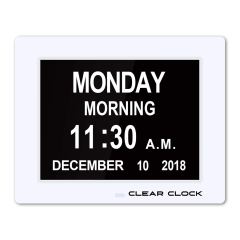
- A clock that sets itself automatically, and includes the date and the day of the week. The Clear Clock (pictured below) is particularly helpful because of its simple screen and the fact that it identifies morning, afternoon, evening, and night.
- A simplified cell phone. The Jitterbug flip phone, widely available, is probably one of the simplest, with large buttons and easy-use features. You can preprogram frequently used numbers.
- A talking watch – while your partner may not have a vision problem, they may not be able to interpret the time shown on a watch.
- A simplified remote control. The simplest ones are easy to use, but will not work with cable or satellite service. I put small labels on our remote control highlighting the most frequently used buttons, so my husband could find them easily.
- A “home assistant” such as Amazon’s Alexa or Google Home. Your partner won’t be able to set it up, most likely, but once it is set up, it may be helpful if they can remember how to use it for reminders, turning the TV on and off, and listening to music.
Experiences
Sometimes the best gift you can give is not an object, but an experience. Be sure to take plenty of pictures so you can revisit the experience when your partner’s memory of it wanes. Consider these options, depending on your partner’s abilities and interests:
- A meal in a favorite restaurant. (Make sure this is not going to be overwhelming.)
- A local concert, where you can leave early if necessary.
- A museum trip to a museum that represents your partner’s interests. My husband really enjoyed going to an antique car museum with his son. Some museums even have specialized support for those with cognitive disabilities. We took a private tour of the Portland Art Museum. I called ahead and explained my husband’s situation, and the terrific volunteer who conducted the tour selected a few paintings of the Grand Canyon for us to focus on, brought folding stools so we could sit down, and tailored her comments to our needs. It was a wonderful experience.
- A short boat tour. Many places have one- or two-hour cruises.
Games
Simple games can help to stimulate memory skills and provide social enjoyment. Dominoes and board games like “Sorry” may be good choices. If you have younger family members who will play with you, you can justify getting a simple game because they will be able to play as well.
Gifts for You
If a friend or family member asks what you might like for a gift, don’t hesitate to ask for what you want and need.
- Suggest that they take your partner out for something enjoyable (ice cream, or a movie) so that you can have time alone at home or to do something you would like.
- If your partner is still interested in getting you a gift, but is having difficulty with the logistics, ask the friend to take your partner to a store and help them purchase something for you. You may have to give the friend gift suggestions to help, and suggest a smaller store rather than a large confusing place. Be sure the friend knows how much help and support your partner will need (for example, is your partner still able to manage paying for something independently?).
- Ask your friend or family member to join you and your partner in playing a game or going out for breakfast. It may be hard on you to enjoy these activities when your partner is not able to converse very much, and it could be fun to have others join you.
The next post will be on gifts for those with moderate or advanced dementia.
 Alz Partner